
Introduction
Missing a tooth is more than a cosmetic concern—it can affect chewing, speech, confidence, and the health of surrounding teeth. The World Health Organization estimates that oral diseases affect nearly 3.7 billion people worldwide, with tooth loss being one of the major consequences of untreated dental disease. For many patients, Dental Implants in Chennai offer a long-term option for replacing missing teeth, but treatment is not the same for everyone. Bone condition, gum health, overall health, implant placement, and restoration choices can all influence the treatment plan. In fact, a 2026 systematic review found a 93% estimated 20-year implant survival rate, highlighting their potential for long-term tooth replacement. This guide explains what to know before choosing treatment.
What Are Dental Implants?
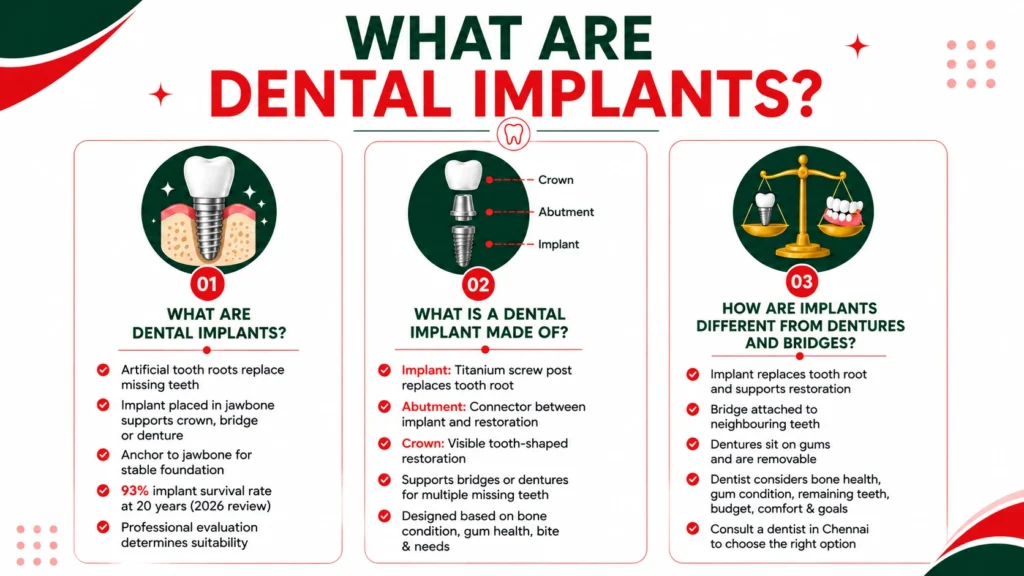
Dental implants are artificial tooth roots that help replace missing teeth. A dentist places a small implant, usually made from titanium, into the jawbone. The implant then supports a crown, bridge, or denture, depending on the patient’s needs. Unlike traditional dentures, implants anchor directly to the jawbone, which can provide a stable foundation for replacement teeth. A 2026 systematic review of 1,857 implants found an estimated 93% implant survival rate at 20 years, although individual results vary with oral health, maintenance, smoking, bone condition, and other factors. For people considering Dental Implants in Chennai, a professional evaluation can determine whether implants suit their oral health and tooth-replacement goals.
What Is a Dental Implant Made Of?
A dental implant typically consists of three main parts, and each part plays a specific role in rebuilding a missing tooth:
- Implant: A screw-shaped post, commonly made from titanium, that sits inside the jawbone and replaces the missing tooth root.
- Abutment: A connector that joins the implant to the final dental restoration.
- Crown: The visible tooth-shaped restoration that sits above the gum and restores the appearance and function of the missing tooth.
Dental implants can also support bridges or certain types of dentures when patients have multiple missing teeth. The dentist chooses the implant design and restoration according to your bone condition, gum health, bite, number of missing teeth, and overall treatment needs. This personalized planning helps create a stable and functional result.
How Do Dental Implants Replace Missing Teeth?
Dental implants replace missing teeth by creating a stable foundation inside the jawbone. Your dentist first evaluates your teeth, gums, and available bone before planning the procedure. The implant then takes the place of the missing tooth root and supports the final restoration.
The typical process involves:
- Consultation: Your dentist checks your oral health and treatment requirements.
- Treatment planning: Dental imaging helps assess the implant site and surrounding structures.
- Implant placement: The dentist places the titanium implant into the jawbone.
- Healing: The implant integrates with the surrounding bone over time.
- Restoration: A crown, bridge, or denture connects to the implant.
A single implant placement can take around 30 minutes in some clinical settings, although the complete treatment takes much longer because healing and restoration require additional stages.
How Are Implants Different From Dentures and Bridges?
Dental implants, bridges, and dentures can all replace missing teeth, but they work differently. An implant replaces the missing tooth root and supports a crown, bridge, or denture. A traditional bridge fills the gap by attaching to neighboring teeth, while dentures sit over the gums and remain removable.
For example, imagine you lose one front tooth. An implant can support an individual crown without preparing the neighboring teeth. If you lose several adjacent teeth, a bridge may fill the gap, while a partial denture offers a removable option.
Your dentist should consider your bone health, gum condition, remaining teeth, budget, comfort, and treatment goals before recommending an option. For patients exploring Dental Implants in Chennai, a clinical consultation can help identify the most suitable tooth-replacement approach.
Who Can Consider Dental Implants in Chennai?
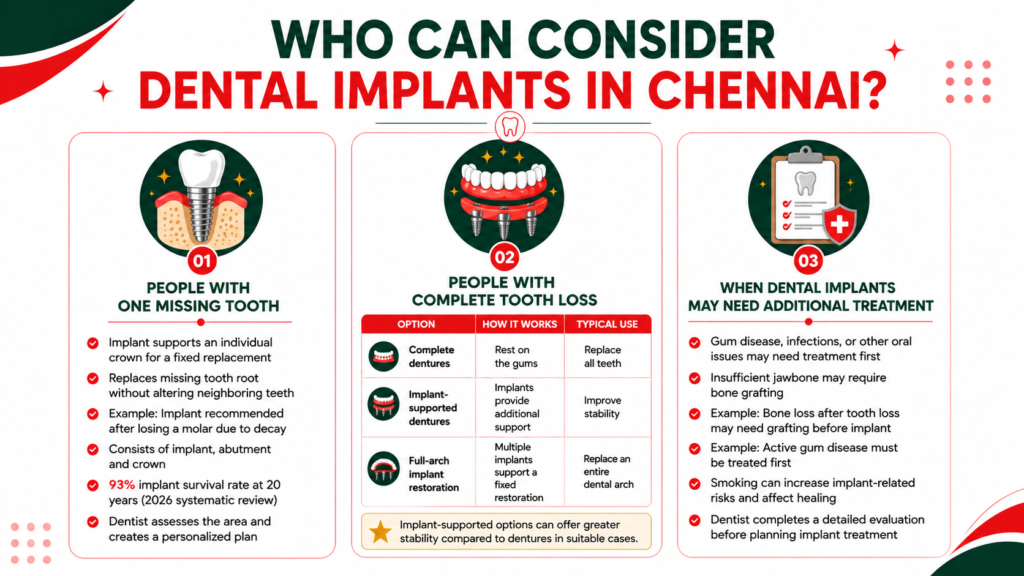
Dental implants can help adults who have lost one or more teeth and want a stable tooth-replacement option. However, not everyone automatically qualifies. Dentists assess gum health, jawbone condition, oral hygiene, general health, and treatment goals before recommending implants. The American Academy of Implant Dentistry notes that millions of dental implants go into place each year in the United States, showing how widely clinicians use this treatment for tooth replacement. For people considering Dental Implants in Chennai, a consultation can identify whether an implant suits their specific situation. Your dentist may also recommend preliminary treatment before implant placement.
People With One Missing Tooth
A single missing tooth can affect chewing, speech, appearance, and the surrounding teeth. A dental implant can provide a fixed replacement by supporting an individual crown. Unlike a conventional bridge, the implant replaces the missing tooth root and can avoid preparing the neighboring healthy teeth for crowns.
For example, imagine you lose a molar because of severe decay. Your dentist may recommend an implant and crown after checking your bone and gum health.
A single-tooth implant typically involves three components: the implant fixture, abutment, and crown. Clinical evidence also shows strong long-term outcomes for implants; a 2026 systematic review estimated a 93% implant survival rate at 20 years, although individual outcomes vary.
For Dental Implants in Chennai, your dentist can assess the missing-tooth area and create an individualized treatment plan.
People With Complete Tooth Loss
Complete tooth loss does not necessarily mean you must rely only on conventional removable dentures. Dentists can use implants to support different types of prosthetic teeth, depending on your bone, gum health, medical history, and treatment goals.
| Option | How It Works | Typical Use |
| Complete dentures | Rest on the gums | Replace all teeth |
| Implant-supported dentures | Implants provide additional support | Improve stability |
| Full-arch implant restoration | Multiple implants support a fixed restoration | Replace an entire dental arch |
For example, a patient with complete tooth loss may struggle with denture movement while eating. An implant-supported option may provide greater stability if the patient’s clinical assessment supports it.
When Dental Implants May Need Additional Treatment
Some patients need additional dental treatment before they can proceed with implants. Your dentist may first address gum disease, tooth infections, bone loss, or other oral health concerns. Insufficient jawbone can also affect implant planning, and a dentist may recommend bone grafting in selected cases.
For example, imagine a patient lost a tooth several years ago and now has reduced bone volume in that area. The dentist may recommend a bone-grafting procedure before implant placement. Another patient may have active gum disease, so treating the gums may become the first priority.
Smoking can also increase implant-related risks and affect healing.
For Dental Implants in Chennai, your dentist should complete a detailed evaluation before deciding whether you need additional treatment.
What Are the Benefits of Dental Implants?
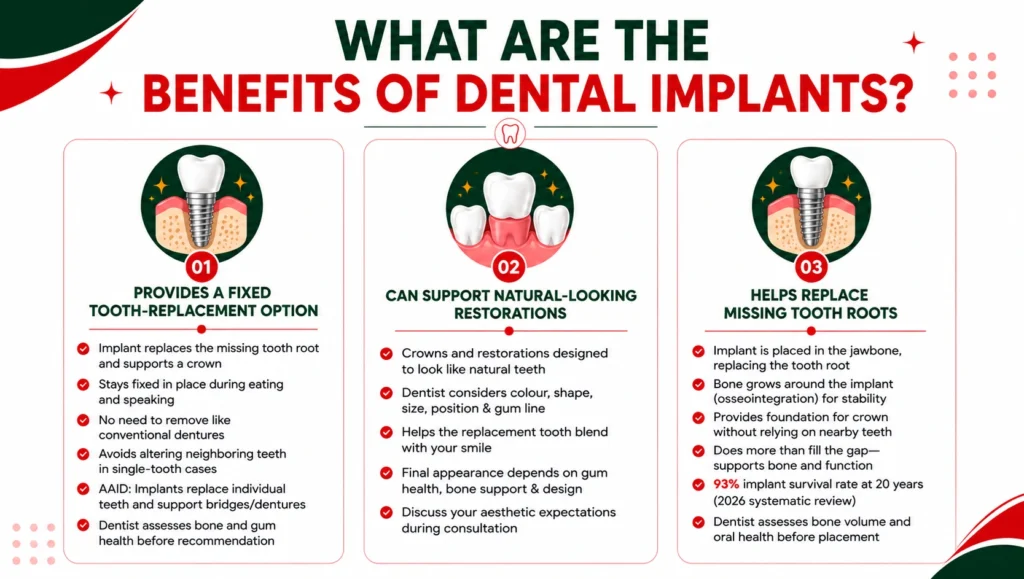
Dental implants offer a stable way to replace missing teeth while supporting everyday functions such as chewing and speaking. Unlike removable dentures, implants anchor into the jawbone and can support crowns, bridges, or dentures. They also provide a way to replace a missing tooth without relying on neighboring teeth for support in many single-tooth cases. Long-term research shows encouraging results: a 2026 systematic review estimated a 93% implant survival rate at 20 years, although individual outcomes vary with oral hygiene, smoking, bone health, and maintenance.For people considering Dental Implants in Chennai, a professional assessment can help determine whether these benefits apply to their situation.
Provides a Fixed Tooth-Replacement Option
Dental implants can provide a fixed tooth-replacement option that stays in place during normal activities. An implant replaces the missing tooth root, while a crown provides the visible tooth structure. This design can give patients a stable foundation for biting and chewing compared with conventional removable dentures.
For example, if you lose one molar, an implant-supported crown can fill that gap without requiring you to remove the replacement while eating or speaking. In a suitable single-tooth case, the dentist can also avoid preparing the neighboring teeth for a conventional bridge.
According to the American Academy of Implant Dentistry, implants can replace individual teeth as well as support bridges and dentures.
If you’re considering Dental Implants in Chennai, your dentist can assess your bone and gum health before recommending a fixed implant restoration.
Can Support Natural-Looking Restorations
Dental implants can support crowns and other restorations designed to resemble natural teeth. Your dentist and dental laboratory consider factors such as tooth colour, shape, size, position, and the surrounding gum line when planning the final restoration. This attention to detail can help the replacement tooth blend with your smile.
For example, if you lose a front tooth, your dentist can select a crown shade that matches the surrounding teeth and design its shape to complement your smile. However, the final appearance depends on factors such as gum health, bone support, restoration design, and individual anatomy.
For patients exploring Dental Implants in Chennai, discussing your aesthetic expectations during the consultation can help your dental team plan a restoration that suits your smile.
Helps Replace Missing Tooth Roots
A dental implant serves a different purpose from a conventional crown or denture because it replaces the root portion of a missing tooth. The dentist places the implant into the jawbone, where bone can grow around its surface during healing. This process, called osseointegration, helps create a stable foundation for the restoration.
For example, when a patient loses a molar, placing an implant can provide support for a crown without depending on the neighboring teeth. The implant does not simply fill the visible gap; it provides a foundation beneath the gum.
Clinical evidence supports the long-term potential of implant treatment. A 2026 systematic review estimated a 93% implant survival rate at 20 years, although results vary between patients.
For Dental Implants in Chennai, your dentist should assess bone volume and oral health before recommending implant placement.
Why Choose Peach Dental Clinic for Dental Implants in Chennai?
Choosing an implant clinic involves more than comparing prices. Patients should look at clinical evaluation, treatment planning, technology, convenience, and follow-up care. Peach Dental Clinic offers dental implant treatment as part of its dental services and has locations in Kilpauk and Porur, making follow-up visits more convenient for Chennai patients.
| What to Consider | Peach Dental Clinic |
| Implant treatment | Available |
| Chennai locations | Kilpauk & Porur |
| Consultation | Treatment assessment before care |
| Patient approach | Personalized treatment planning |
For example, a patient replacing one missing tooth may need a clinical examination, imaging, implant placement, healing, and a final crown. A consultation helps the dental team determine the appropriate treatment sequence. If you’re exploring Dental Implants in Chennai, Peach Dental Clinic can help you understand your options before proceeding.
Modern Dental Technology
Modern dental technology can help dentists examine oral structures, plan implant placement, and evaluate the area around a missing tooth more precisely. Peach Dental Clinic highlights technology and modern dental care as part of its approach to treatment. Peach Dental Clinic
For example, appropriate dental imaging can help a dentist evaluate available bone and important anatomical structures before implant placement. Digital planning can also help the dental team visualize the proposed treatment and coordinate the final restoration.
Technology does not replace clinical expertise. Instead, it supports the dentist’s examination and treatment decisions. Your dentist still needs to consider factors such as gum health, bone condition, bite, medical history, and oral hygiene.
If you are considering Dental Implants in Chennai, ask the clinic which diagnostic and planning technologies they recommend for your specific case.
Convenient Chennai Locations
Dental implant treatment usually involves more than one appointment, so choosing a clinic that you can reach conveniently can make the treatment journey easier. Peach Dental Clinic operates from two Chennai locations, giving patients options based on their location and appointment requirements.
Patients can consider:
- Kilpauk: Convenient for patients living or working around central Chennai.
- Porur: Useful for patients in and around western Chennai.
- Follow-up visits: Convenient access can make it easier to attend scheduled reviews.
- Treatment coordination: Patients can discuss their treatment plan with the dental team before proceeding.
For example, an implant patient may need consultation, treatment, healing reviews, and restoration appointments. Planning these visits becomes easier when the clinic location fits your routine.
If you’re researching Dental Implants in Chennai, consider both clinical expertise and the practical convenience of attending follow-up appointments.
Consultation Before Treatment
A consultation gives your dentist an opportunity to understand your oral health and determine whether an implant suits your needs. Before recommending treatment, the dentist may examine your gums, remaining teeth, bite, jawbone, and the area where you lost the tooth. Appropriate dental imaging can provide additional information for treatment planning.
For example, a patient who lost a tooth several years ago may have different bone conditions from someone who lost a tooth recently. One patient may need only implant placement and a crown, while another may require treatment for gum disease or bone loss first.
A consultation also lets you ask about treatment stages, expected healing, restoration choices, maintenance, and cost factors. For patients considering Dental Implants in Chennai, this discussion helps replace assumptions with a personalized treatment plan.
Conclusion
Choosing Dental Implants in Chennai starts with understanding more than the procedure itself. Your gum health, jawbone condition, number of missing teeth, overall oral health, treatment goals, and long-term maintenance all influence the right treatment plan. Dental implants can provide a stable foundation for crowns, bridges, or implant-supported dentures, but a qualified dentist must assess your individual needs before treatment.
At Peach Dental Clinic, a detailed consultation can help you understand your treatment options, expected treatment stages, recovery requirements, and cost considerations. Whether you have one missing tooth or several missing teeth, getting professional advice can help you make a confident, informed decision.
Ready to explore your options? Schedule a consultation with Peach Dental Clinic and take the first step toward restoring your smile, comfort, and confidence.
Frequently Asked Questions About Dental Implants in Chennai
1. What are dental implants?
Dental implants replace missing tooth roots and support crowns, bridges, or dentures.
2. Who can get dental implants?
Adults with suitable oral health and adequate bone may qualify after a dentist’s evaluation.
3. How long does dental implant treatment take?
Treatment time varies based on bone health, healing, and whether additional procedures are necessary.
4. Are dental implants painful?
Dentists use local anesthesia during placement. You may experience some discomfort during recovery.
5. How much do dental implants cost in Chennai?
The cost varies with the implant system, restoration, number of implants, and additional procedures.
6. Are dental implants permanent?
Implants can provide long-term tooth replacement, but proper hygiene and regular dental care remain essential.
7. Do I need bone grafting?
Not everyone needs grafting. Your dentist assesses your available jawbone before treatment.
8. How do I choose an implant dentist in Chennai?
Check qualifications, experience, treatment planning, technology, reviews, and follow-up care.
9. Can smokers get dental implants?
Smoking can increase complications and affect healing, so discuss your smoking history with your dentist.
10. Where can I get dental implants in Chennai?
Peach Dental Clinic offers dental implant consultations at its Kilpauk and Porur locations.